
Surprising fact: More than 40% of small and medium ventures pick a sociedad that limits partner risk, and that choice shapes how we enter the local mercado.
We define an empresa structure where each partner’s liability is limited to their contribution. That means partners are not personally liable for business debts and we can protect personal assets while we grow the negocio.
In practical terms, creating this sociedad starts with defining the objeto social and razón social, drafting incorporation documents and registering with the Cámara de Comercio to get the matrícula mercantil.
Key features include partner limits, a required corporate purpose, and public deed norms unless we meet small-entity exceptions. We will compare this ruta to SAS and SA to weigh beneficios and características for our estructura empresarial.
Key Takeaways
- Liability ties to partner contributions, protecting personal assets.
- Register with Cámara de Comercio and secure matrícula mercantil.
- Define corporate purpose and choose public deed or private route.
- Compare sociedad types to pick the right estructura for our negocio.
- Plan governance, accounting and tax steps before we crear empresa.
Understanding the Sociedad de Responsabilidad Limitada in Colombia
In practice, this tipo of sociedad limits personal exposure so partners answer only up to their capital share. Responsabilidad limitada means creditors can claim against the empresa, not each partner’s personal assets.
How it works: partners’ liability equals their contributed capital. This preserves individual patrimonio and reduces personal financial risk during litigation or debt collection.
Compared with a SAS, the sociedad requires a defined social purpose and normally a public deed for incorporation. An exception allows a private document when the empresa has under 10 employees or assets below 500 SMMLV.
- Governance: Asamblea de socios sets major decisions.
- Management: a gerente runs daily operations; a consejo de administración is optional.
- Oversight: a revisor fiscal applies when thresholds demand formal review.
| Feature | Effect | When it matters |
|---|---|---|
| Responsabilidad limitada | Protects partner assets | Debt, litigation, creditor claims |
| Propiedad by quotas | Admission/exit rules differ from share transfer | Ownership changes, inheritance, partner exits |
| Public deed norm | Greater formality and notarization | Standard incorporation; private doc exception for small firms |
This tipo of empresa suits closely held and family ventures that seek clear governance and predictability. Next, we will quantify partners, capital duties, and the documentation needed to keep these protections intact. Es fundamental considerar las normativas locales y los requisitos legales a la hora de iniciar un negocio en Colombia. Además, una adecuada planificación financiera y la definición de roles dentro de la empresa favorecen la estabilidad y el crecimiento a largo plazo. Por último, establecer mecanismos de resolución de conflictos es esencial para mantener la armonía entre los socios.
Key Characteristics of an LTDA We Should Know
We examine the attributes that shape partner risk, governance, and funding.
Limited liability tied to partner contributions
Liability limited means each partner answers only up to the paid-in quota. This protection holds when formalities and records are kept current.
Number of socios and ownership limits
An LTDA requires a minimum of two and a maximum of 25 socios. That number of shareholders suits small and mid-sized ventures and limits excessive ownership fragmentation.
Defined corporate purpose and scope
The purpose must be explicit in the bylaws. Activities outside that scope can cause compliance and contract risks.
Capital, payment rules and practical thresholds
Capital contributions must be paid in full at incorporation. Payments can be cash or in kind, but in-kind assets need valuation and formal accounting entries.
Small firms (fewer than 10 employees or assets below 500 SMMLV) may use a private incorporation document, easing early steps.
| Feature | Requirement | Practical effect | Why it matters |
|---|---|---|---|
| Liability | Limited to contribution | Protects personal patrimonio | Reduces creditor reach to partners |
| Socios count | 2–25 partners | Suited for close-held governance | Affects transfer rules and deadlocks |
| Purpose | Defined in bylaws | Narrower activity scope than SAS | Ensures contractual clarity |
| Capital | Paid in full at start | Stronger balance sheet | Helps registration and bank setup |
Incorporation Process: How We Create an LTDA Step by Step
We start the incorporation process by drafting clear bylaws that state purpose, capital, quotas, governance, and profit allocation.
Drafting bylaws and the incorporation document
Step one is a precise bylaws draft. It must list capital contributions and payment proof so we can constituir sociedad without delays.
Public deed versus private document
Normally the incorporation must be a public deed before a notary. A private document is allowed when we have under ten employees or activos below the statutory threshold.
Registering and tax steps
We file with the Cámara de Comercio for name clearance and matrícula mercantil. Then we apply for the número identificación to enable invoicing, payroll, and DIAN interaction.
Bank account and statutory books
Opening a corporate bank account requires bylaws, ID, and proof of registration. We also set statutory books (shareholder register and minutes) and keep timely entries for audits.
- Verify partner IDs and consistent names.
- Confirm full capital payment evidence.
- Appoint legal representative and registered office.
ltda company colombia: Requirements, Documents, and Timing at present

Before we file, we must confirm the practical requisitos and a realistic timing plan. Small missteps on paperwork or capital proof often cause the longest delays.
Minimum and maximum partners: The mínimo is two and the cap is 25; this number of partners matches close-held governance and speeds decisions when roles align with skills.
Minimum and maximum partners, capital contributions, and verification
Capital must be fully paid at incorporation. Acceptable evidence includes bank slips for cash and valuation reports for in-kind aportes. Founders commonly set the capital level; some guides reference 100 SMMLV (2023 ≈ COP 103,380,000) but there is no fixed statutory floor in many sources.
We verify partner IDs, signatures, and aporte documentation before filing. This reduces queries from registro staff and speeds the proceso.
Core documentation checklist for smooth filing
- Bylaws/incorporation document with capital breakdown and purpose (use correct CIIU codes).
- Partner IDs and proof of payment for contributions.
- Appointment of legal representative and registered office address.
- Statutory books and minutes setup for ongoing registros.
- Valuation reports for in-kind aportes and any notarized deeds if required.
| Step | What to provide | Timing |
|---|---|---|
| Name search & filing | Forms, fees, matrícula mercantil request to cámara comercio | 2–7 business days (depends on workload) |
| Notarization (if needed) | Public deed or private document when activos | 1–5 business days |
| Final registration | Statutory books and filing receipts | 1–3 business days |
Practical tips: Pre-validate tax activity codes, keep a verification workflow (legal review, identity checks, capital proof), and assign clear responsabilidad for signatures and internal controls. Finally, store notarized deeds, certificates, and books in a secure document vault for audits, tenders, and bank KYC.
LTDA vs SAS vs SA: Which Structure Fits Our Business Model?
Choosing the right legal structure affects how we raise capital, control risk, and scale our negocio.
Governance and control differ sharply. An SAS gives fast setup and one shareholder, so accionistas can move quickly with few formalities. An LTDA centers control in the Asamblea de socios with quota-based ownership and stricter transfer rules. Sin embargo, las SAS pueden enfrentar limitaciones de las empresas SAS, que incluyen restricciones en la capacidad de captar inversión externa y la dificultad para expandir significativamente su estructura de capital. Por otro lado, la LTDA, al ofrecer una gobernanza más estructurada, puede atraer a inversionistas buscando mayor seguridad y participación en la toma de decisiones. Así, la elección entre una SAS y una LTDA depende de las necesidades específicas y la estrategia de crecimiento de los accionistas.
An SA requires a board and suits larger ownership groups. That structure can improve investor confidence but adds oversight and meetings.
Purpose and operational flexibility
Some sociedades allow broad activities. An SAS often accepts an open-ended purpose, easing pivots in our modelo negocio.
By contrast, LTDA and SA require a defined purpose, which can limit sudden business shifts but offers clearer contractual scope.
Capital, financing and growth
Financing paths vary: SAS structures favor venture rounds and easy onboarding of nuevos accionistas. LTDA fits close-held growth. SA is tailored for many accionistas and institutional capital.
| Aspect | Best fit | Why it matters |
|---|---|---|
| Governance | SAS / LTDA / SA | Control, board needs, veto rights |
| Purpose | SAS (flexible) / LTDA & SA (defined) | Pivots vs contractual clarity |
| Financing | SAS (angel/venture) / SA (institutional) | Speed-to-market and crecimiento |
Decision tip: match our propiedad goals, investor appetite, and compliance tolerance to pick the tipo that balances speed, control, and long-term beneficios for the empresa.
Ownership, Governance, and Control in an LTDA
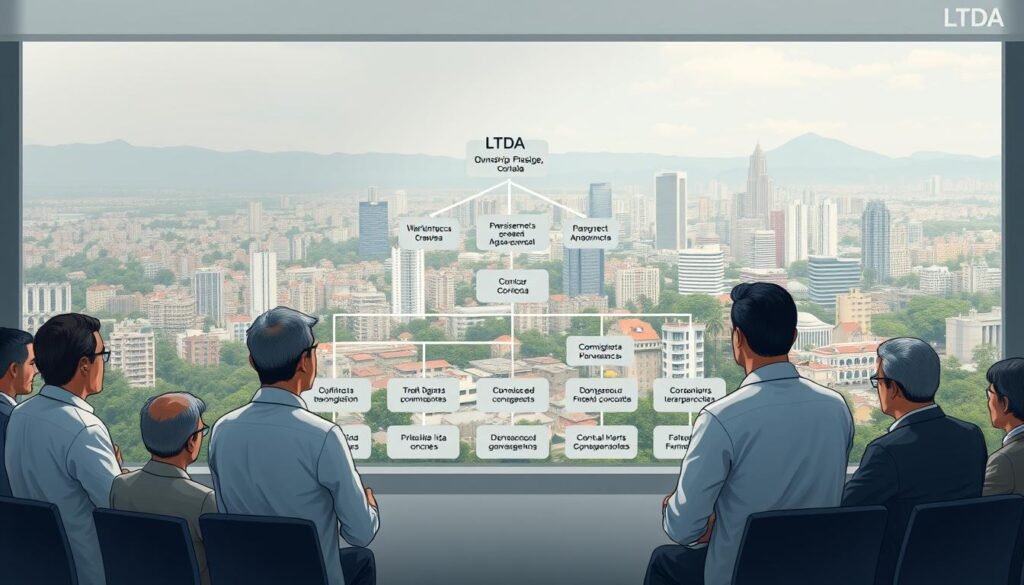
Good governance starts with clear roles: who decides, who executes, and how we document those actions.
Asamblea de socios and decision-making
The Asamblea de socios is the supreme body of the sociedad. It approves financial statements, profit distribution and bylaw amendments.
We set voting rules, quorums and the número and cadence of meetings. Minutes and statutory books record each decisión and protect the empresa in disputes.
Management and oversight
The gerente runs daily operations, signs contracts and implements board or Asamblea mandates.
An optional consejo de administración adds strategic control and stronger internal control when growth demands it.
Revisor fiscal: when and what
A revisor fiscal becomes mandatory once thresholds trigger audits. Their duties include reviewing accounts, checking tax filings and reporting irregularities.
- We use socios acuerdos to align transfer limits, preemptive rights and deadlock fixes.
- We keep a governance calendar for ordinary and extraordinary decisiones, budgets and audit cycles.
- Administrators face legal responsabilidad; D&O insurance can reduce personal risk.
Clear governance boosts bank confidence and makes investor due diligence easier. Consistent records and simple internal policies keep the empresa resilient as we scale.
Compliance, Taxes, and Ongoing Obligations in Colombia
Managing taxes, audits, and reporting obligations is essential to preserve our limited liability protections. We must keep statutory books, file annual returns, and register foreign investment when relevant.
Accounting and NIIF thresholds
NIIF adoption follows a tiered framework: larger empresas must prepare IFRS-based statements and face mandatory audits when ingresos or activos exceed legal thresholds.
We plan resources early to meet audit cycles, staff accounting, and external auditor coordination with the revisor fiscal.
Taxes, VAT and dividend distribución
Corporate income tax stands at 35% and VAT at 19%. Dividend distribución is taxed between 0% and 20%, affecting owners’ after-tax returns.
Transfer pricing and cross-border rules
Cross-border related-party transactions require contemporaneous documentation, a local file and, when applicable, a master file to prove arm’s length pricing and reduce audit exposure.
- Withholdings on services and payments abroad must follow treaty relief when available.
- Practical controls: segregation of duties, expense policies, and inventory verification.
- Reinvested capital and reserves strengthen solvency and bankability.
| Obligation | Key rate/threshold | Effect |
|---|---|---|
| Corporate tax | 35% | Reduces net profit available for distribución |
| VAT | 19% | Affects pricing and cash flow |
| Dividend tax | 0–20% | Impacts owner returns and payout timing |
Strong compliance practices protect our responsabilidad limitada and boost access to credit, public procurement, and trusted vendor terms in the mercado.
Next Steps to Confidently Form an LTDA in Colombia
Let’s map simple, practical steps to finish the incorporation process and start operating with confidence.
We will schedule the key pasos: draft bylaws, choose public deed or eligible private document, register with Cámara de Comercio to obtain the matrícula mercantil, secure the NIT, open a bank account, and keep statutory books current.
Ownership design must specify how many socios, each socio’s aportes and voting rules so decisiones are clear. Liability limited hinges on proper constitución, accurate accounting, and strict separation of personal funds.
Choose the right tipo — LTDA for close control, sociedad acciones simplificada when speed and funding matter, or SA for larger accionistas. For practical help, consult our company formation services and engage a lawyer, accountant, and banker to execute the plan smoothly.