
One in three new companies in Colombia choose a flexible corporate type after 2008; that shift changed how we form a sociedad and how we plan growth.
We introduce how the choice of sociedad shapes our empresa’s governance, liability, and path to scale. The two leading opciones—Sociedad por Acciones Simplificada and Sociedad de Responsabilidad Limitada—offer clear trade-offs.
The simplified form lets one or more shareholders set flexible rules and register by private document at the Cámara de Comercio, except when in-kind contributions need a public deed.
The limited partner model requires 2–25 partners, a public deed at formation, fully paid capital, and tighter rules on quota transfers. Both give limited liability, but they differ in control, transferability, and risk for labor or tax claims.
Key Takeaways
- We must match the tipo sociedad to our growth and control goals.
- Sociedad por Acciones Simplificada offers flexibility in governance and ownership.
- Sociedad de Responsabilidad Limitada favors partner control and limits transfers.
- Registro at the Cámara de Comercio and relevant leyes guide formation and formalities.
- Our choice affects investor, bank, and supplier perceptions from day one.
How we frame the comparison for entrepreneurs in Colombia today
We frame the comparison around the practical trade-offs entrepreneurs face when choosing a legal vehicle.
Speed to incorporate, governance flexibility, and investor appeal are the core características we weigh. Each sociedad brings different rules for formation, control, and transfers.
The legal framework for sociedades comerciales requires careful attention to documentation, registration at the Chamber of Commerce, and statutory compliance. Our compliance posture and the cuenta we keep of obligations shape operational discipline from day one.
- Match the tipo sociedad to your operations, risk tolerance, and growth goals.
- Consider market norms and banks’ expectations when assessing credit and supplier terms.
- Map each option to clear use cases for different personas emprendedoras in Colombia.
We also dispel common myths about transferability and partner control so decisions rest on facts, not assumptions. In the sections ahead we compare sociedades line by line and connect legal requirements to daily management realities for sociedades comerciales colombia.
sas vs ltda colombia: a head‑to‑head look at structure, liability, and flexibility
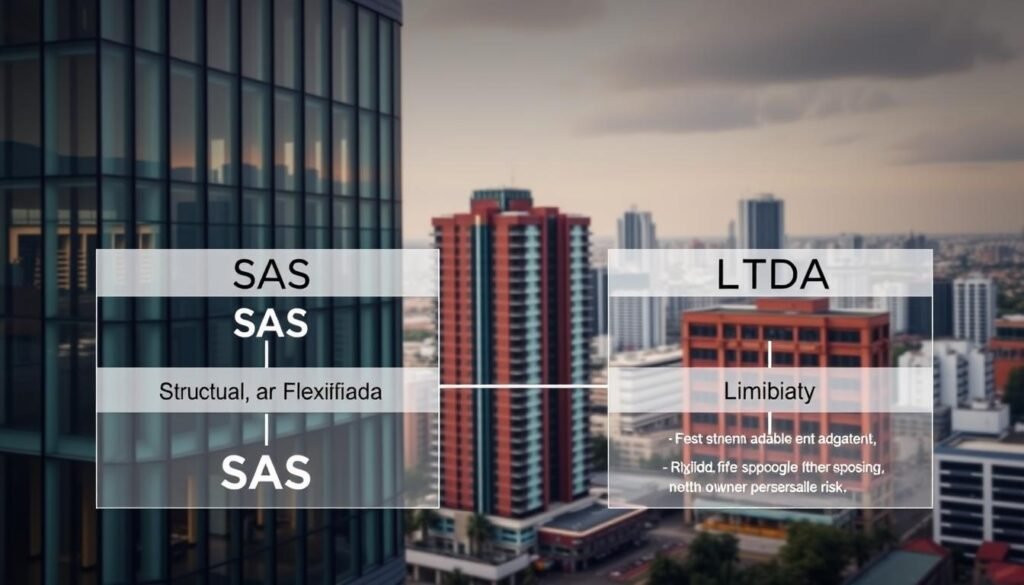
This concise comparison maps the core características that shape how we form and run a sociedad and how that choice affects our empresa.
Incorporation mechanics
One form may be constituted by private document and registered at the Chamber of Commerce, with public deed only if aportes require it. The other requires a public deed at formation and then registration.
Who can participate
We can have a single accionista or multiple participants in one model, while the alternative limits membership to between two and twenty‑five socios, which affects control and governance.
Capital, ownership and liability
Capital payment can be flexible—up to two years for subscribed aportes—versus a requirement of fully paid capital at formation in the other structure.
Shares or acciones may be freely negotiable and allow classes; quotas limit transfers and usually need approvals. Both limit responsabilidad to aportes, but joint exposure for labor and tax claims can attach to socios in the quota model.
| Feature | Shares model | Quotas model |
|---|---|---|
| Transferability | More negotiable | Restricted |
| Governance | Optional board; flexible órganos | Managers; junta de socios |
| Regulated actividades | Cannot perform some regulated actividad | Depends on authorization |
The legal backbone we must consider before choosing
A practical choice depends on understanding which laws and documents shape capital, control, and obligations.
Key statutes
Primary legal frameworks
We anchor the analysis in Ley 1258 de 2008 for the SAS model and in the Código de Comercio plus Ley 222 de 1995 for the quota model. These rules define how we draft constitutive documents, how registro works, and what ongoing obligaciones bind our empresa.
Formation and aportes
SAS can form by private document with Chamber of Commerce registro, unless aportes in assets demand a public deed at the momento of transfer. A Ltda. requires public deed and fully paid capital at formation.
- Capital and monto aportes: value in money or in-kind must be documented in our constitutive papers and the cuenta of ownership.
- Acciones vs quotas: acciones allow classes and transferability; quotas face approval rules under the Código de Comercio.
- Alternatives: sociedad comandita (including comandita simple and sociedad comandita acciones) and empresa unipersonal serve specific governance and liability needs.
| Aspect | Law | Effect |
|---|---|---|
| Formation document | Ley 1258 / Código Comercio | Private or public deed; registro |
| Capital | Ley 222 1995 | Payment rules; monto aportes recorded |
| Audit | Código Comercio | Revisor fiscal triggers by thresholds |
Day‑to‑day operations, administration, and compliance in each model

How we organize day-to-day tasks shapes risk, accountability, and continuity for our sociedades.
Administrative bodies and statutory auditor triggers
We map governance to the chosen form. One model lets us tailor governance and set a board if we wish. The other depends on one or more managers appointed by the junta under the código comercio.
Both must name a revisor fiscal when assets reach 5,000 SMMLV or income 3,000 SMMLV. That appointment raises audit cycles, reporting, and internal controls.
Records, decisions, and bylaw changes
We keep minute books, shareholder and partner registers, and evidence of aportes. Major changes require timely registro at the Chamber of Commerce.
Accionistas can design classes of acciones to allocate votes. Socios use a junta with tighter formalities for transfers and amendments.
- Track capital payments and valuations to protect ownership rights.
- Translate obligaciones into routines: tax filings, labor compliance, and scheduled governance meetings.
- Define succession rules to ensure operación and continuación when managers, accionistas or socios change.
| Topic | Practical effect |
|---|---|
| Activities in bylaws | Scope controls the actividad we may carry out and future approvals |
| Record-keeping | Enables enforceability and fast registro of reforms |
| Audit triggers | Impose revisor fiscal duties and fuller disclosures |
Clear routines help us meet obligaciones as sociedades comerciales and adapt our tipo as operations evolve.
Ownership control, fundraising potential, and exit paths
Ownership rules and exit mechanics define how our empresa grows and how investors engage with us. We focus on how admitting capital, transferability, and departures shape control and liquidity.
Admitting investors
We can design investor rights to match growth plans. A sociedad acciones simplificada lets us issue multiple classes of acciones with tailored voting and dividend rights. That design helps attract institutional capital while preserving founder control.
By contrast, a sociedad responsabilidad limitada admits new socios only with partner approvals and formal steps tied to capital and aportes.
Liquidity and transfers
Marketability matters for exits. Shares in an acciones model are generally more negotiable and support secondary sales. Quotas prioritize partner stability and restrict transfers, which shields patrimonio but limits quick exits.
Partner departures and continuity
Exits in a sociedad acciones often occur via share transfers or redemptions under bylaws. In a quota model, departures may trigger partner votes, bylaws reforms, or capital adjustments focused on the monto aportes and the cuenta of ownership.
- We track capital and cap table details to keep ownership clear.
- We plan preemptive rights, drag‑along/tag‑along, and transfer windows in advance.
- We weigh control vs. access to growth capital when choosing tipos of ownership.
| Topic | Acciones model | Quota model |
|---|---|---|
| Investor admission | Flexible classes; tailored rights | Partner approval required |
| Transferability | More marketable shares | Restricted transfers; approvals |
| Exit mechanics | Share sale/redemption per bylaws | Statutory steps; possible bylaws change |
For guidance on practical steps and documentation, consult our guide to doing business so we align fundraising with governance and protect the patrimonio of all socios.
Which fits our case? Scenarios to guide a smart decision in Colombia
We select a company form by asking who will run the business, how we will fund it, and how long we plan to keep ownership stable.
Solo founder or startup seeking agility and future investment
For a single founder, we favor a flexible model that supports quick incorporation, investor classes, and modern fundraising tools.
Responsabilidad limitada is preserved while governance stays agile. This path fits many early-stage empresas and growth-minded personas.
Family business prioritizing tight control over partners
When continuity and tight admission rules matter, we choose a structure that limits transfers and keeps decisions within a trusted circle.
We also consider a sociedad comandita for a clear split between managers and passive investors. A comandita simple or a sociedad comandita acciones lets us tailor capital and roles.
- We view empresa unipersonal as an option for single owners who want liability shield but less flexibility than a share-based model.
- Match capital needs, succession plans, and governance culture to the tipo sociedad we select.
| Scenario | Good fit | Why |
|---|---|---|
| Founder + fundraising | Flexible share model | Speed, investor-friendly rights |
| Family control | Quota-based model | Restricted transfers, stable socios |
| Mixed partners | Sociedad comandita | Split roles: gestores vs comanditarios |
Your next step toward the right company structure in Colombia
Strong, we close with a clear checklist to constituir sociedad and start operations.
First, choose the sociedad and lock the nombre and purpose for registro. Draft bylaws that define capital, governance and how socios act.
Next, set the capital plan and moment to pay, and anticipate obligaciones like tax and labor rules. Plan for a revisor fiscal trigger as we scale.
Finally, select among tipos sociedades and tipos sociedades comerciales that fit your activity, or consider empresa unipersonal where relevant. Build bylaws for continuación and decision workflows so our sociedad comercial runs without interruption.